Posts

What's in a Name: the Meaning of Tyersall
Image
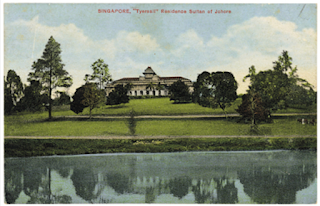
  A turn of the 20th century Singapore postcard showing Tyersall Palace, or Istana Tyersall Most people, as they go about their daily business in Singapore, pay little attention to road names other than remembering where they are for one reason or another. Some may make a mental note that it is a Chinese, Malay, or Tamil-sounding name or one that is left over from colonial times. For a few people, such as Brenda Yeoh, a Professor of Social Sciences at the National University of Singapore and author of several books on the subject, road names are a consuming passion. She has written extensively on the topic including Street Names in Colonial Singapore (1992) and Street-Naming and Nation-Building: Toponymic Inscriptions of Nationhood in Singapore (1996). Such books offer a fascinating spyglass through which to better understand urban history. About a quarter of all road names in Singapore today bear names which tie back to the British colonial period, when roads were first laid dow...


Sultan Abu Bakar, Queen Victoria and the Golden Gift

Image
Abu Bakar's gift to Queen Victoria, a model of the Albert Memorial “A Royal Quest”, Chapter 5 of Palace of Ghosts , is about the lifelong quest of Temenggong Abu Bakar, later Sultan Abu Bakar, to realise his life’s goal: royalty. Like most tasks undertaken by Abu Bakar, failure was never going to be an outcome. To mark the achievement of his goal Sultan Abu Bakar built an enormous palace; Istana Tyersall was a magnificent statement announcing his presence on the world stage. But becoming a Sultan, a sovereign monarch, is not something you fill in an application form for. It requires recognition by people who already had the status you aspired to and, in the 1880s there was no one on earth whose status outshone that of Britain’s Queen Victoria. Victoria and Abdul Shrabani Basu’s brilliant 2010 book Victoria and Abdul: The True Story of the Queen’s Closest Confidant tells the amazing story of an Indian Muslim named Abdul Karim who, on becoming a servant to Queen Victoria in 1887, de...

The Seeds of Prosperity: Where Did All the Money Come From?

Image
At the peak of his reign in the mid 1920s, Sultan Ibrahim of Johor, Sultan Abu Bakar’s son, was reputed to be the wealthiest man in the world. In addition, the loans that his State of Johor provided to the British bankrolled their global Empire. Where did all the money come from?  One of the perennial themes of Palace of Ghosts is wealth. More specifically, wealth accumulation over time. The most visible sign of this outcome was the flamboyant and ostentatious lifestyle of Sultan Ibrahim of Johor in the 1920s and 1930s. He was a product of his times when the rich lived large and cast caution to the monsoon winds. His outrageous playboy antics provide an entertaining subplot to parts of Palace of Ghosts and get him into all sorts of trouble. However, the wealth of the Sultans of Johor did not, of course, just happen. It started with Abu Bakar, and Chapter 5 of Palace of Ghosts , “A Royal Quest”, tells the story of how it happened. Economic Development The economic profile of the e...

The Extraordinary Rise of Sultan Abu Bakar of Johor

Image
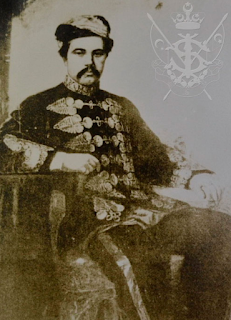
Abu Bakar (1833-1895) was the son of Temenggong Daeng Ibrahim and grandson of Temenggong Abdul Rahman. Temenggong Abdul Rahman was, famously, one the two Malay signatories to the 1819 treaties with the British that allowed them to establish a trading base in Singapore. By the time Abu Bakar succeeded his father as Temenggong in 1862 the other Malay signatory, Tengku Long, had faded into obscurity. That sad fate was not to happen to Abu Bakar: quite the opposite in fact. When Abu Bakar makes his tectonic and far reaching debut appearance in chapter five of  Palace of Ghosts  he is just an eighteen year old youth. Over the course of the next four decades or so he became the highest profile, most charismatic and most wealthy individual that lived in the second half of 19th century Southeast Asia. He eventually founded a new royal dynasty that still exists today (see the recent news articles below). Abu Bakar as a young man Chapter 5 of P alace of Ghosts , A Royal Quest, tells the...

Common Ground: Uncovering Similarities in Cross-Industry Distribution

Image
Overview The skillset I want to highlight in the third and last post of this mini-series on transferable skills (that is ones that I gained in corporate life and I find extremely useful now in my new career as a full-time writer), is the ability to recognise a process that requires a number of its integral components to link up effectively in order to create value by delivering a product to a consumer. After several decades in business leadership, being a keen observer of how markets evolve and having a masochistic interest in economics, I can say with some confidence that one of the things that needs to be quickly understood by anybody entering the corporate world is how distribution, and by extension disintermediation, works. Distribution–how a product gets from its point of creation to the consumer–is at the core of any business, and although all industries have their nuances and peculiarities, the basic principles are similar wherever you look. Understanding such principles, the ba...

The King of Malaysia

Image
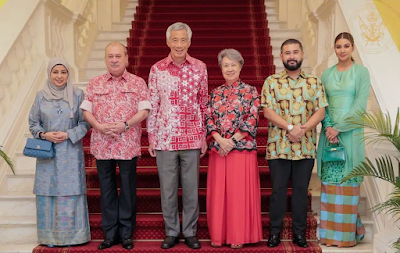
A flurry of news reports this week inform us that Malaysia’s sultans are imminently scheduled to meet and elect the next King of Malaysia from among a set of candidates consisting of only themselves. From the perspective of the Palace of Ghosts story the election, and its outcome, is potentially hugely significant. Singapore Prime Minister Lee Hsien Loong and his wife Madam Ho Ching (centre) hosts the Johor Royals in Singapore in October 2023 The position of King of Malaysia, known in Malay as the Yang di-Pertuan Agong, or simply Agong, was created in 1957 when Malaya gained independence from the United Kingdom. It is, rather uniquely, a rotating office where the Agong is elected by a Conference of Rulers which is made up of the nine traditional rulers of the Malay States. Once elected the Agong remains in office for a period of five years, whereupon another election takes place and a new Agong is elected. The term in office cannot be renewed and what has happened in practice is that ...

Tried and Tested! Life as a Digital Nomad

Image
Transitioning from a corporate career to that of a full-time writer involved many changes and adjustments in my life, both professional and personal, but one of the most intriguing things I found myself contemplating was the idea of a digital nomad approach to working. As an office-bound worker for all my career to date (business trips aside), the whole idea seemed like a some sort of mystical fantasy that would be always out of reach, and perhaps was not all it was cracked up to be anyway, “yes, just keep thinking that”, I thought. As I went through weeks, even months, of adjustment it became apparent that it was no longer out of reach but also beckoned with a strange sense of allure.   In a gallant effort to manage the tug-o-war between discipline and temptation, I pushed away the siren calls and convinced myself that the relevant question which needed answering was whether this was a really a productive way to work and achieve one’s goals, or was it something that people di...