Posts

Showing posts with the label Malaysian history

A Night Like No Other: Sultan Abu Bakar of Johor's Grand Ball at Istana Tyersall in 1895

Image
With the launch of  Palace of Ghosts: Singapore’s Untold History , (available now on Amazon), I wanted to share a highlight event that features prominently in the story.  Click Here to Buy the Paperback Book In 1895, Sultan Abu Bakar hosted a grand ball to celebrate, in an ostentatious fashion, the opening of Istana Tyersall—a momentous occasion marking not only the opening of Istana Tyersall, but also the launch of a new royal dynasty, one officially recognized by Britain’s Queen Victoria.  There are no known photographs of the Sultan's grand ball, but this depiction of a European royal ball, painted by Wilhelm Gause in 1900, showcases a scene that would have been recognizable to attendees of the Sultan's grand ball at Istana Tyersall in 1895. Throughout his life, Abu Bakar was fixated on inheriting the sovereign title of the defunct Johor-Riau Sultanate: Sultan of Johor. The new state of Johor had been under his firm control for decades by the time he finally achieved h...

The Seeds of Prosperity: Where Did All the Money Come From?

Image
At the peak of his reign in the mid 1920s, Sultan Ibrahim of Johor, Sultan Abu Bakar’s son, was reputed to be the wealthiest man in the world. In addition, the loans that his State of Johor provided to the British bankrolled their global Empire. Where did all the money come from?  One of the perennial themes of Palace of Ghosts is wealth. More specifically, wealth accumulation over time. The most visible sign of this outcome was the flamboyant and ostentatious lifestyle of Sultan Ibrahim of Johor in the 1920s and 1930s. He was a product of his times when the rich lived large and cast caution to the monsoon winds. His outrageous playboy antics provide an entertaining subplot to parts of Palace of Ghosts and get him into all sorts of trouble. However, the wealth of the Sultans of Johor did not, of course, just happen. It started with Abu Bakar, and Chapter 5 of Palace of Ghosts , “A Royal Quest”, tells the story of how it happened. Economic Development The economic profile of the e...

The Extraordinary Rise of Sultan Abu Bakar of Johor

Image
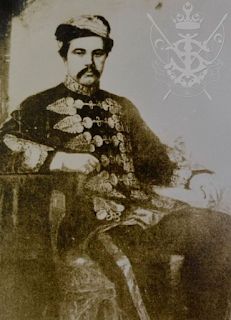
Abu Bakar (1833-1895) was the son of Temenggong Daeng Ibrahim and grandson of Temenggong Abdul Rahman. Temenggong Abdul Rahman was, famously, one the two Malay signatories to the 1819 treaties with the British that allowed them to establish a trading base in Singapore. By the time Abu Bakar succeeded his father as Temenggong in 1862 the other Malay signatory, Tengku Long, had faded into obscurity. That sad fate was not to happen to Abu Bakar: quite the opposite in fact. When Abu Bakar makes his tectonic and far reaching debut appearance in chapter five of  Palace of Ghosts  he is just an eighteen year old youth. Over the course of the next four decades or so he became the highest profile, most charismatic and most wealthy individual that lived in the second half of 19th century Southeast Asia. He eventually founded a new royal dynasty that still exists today (see the recent news articles below). Abu Bakar as a young man Chapter 5 of P alace of Ghosts , A Royal Quest, tells the...

The King of Malaysia

Image
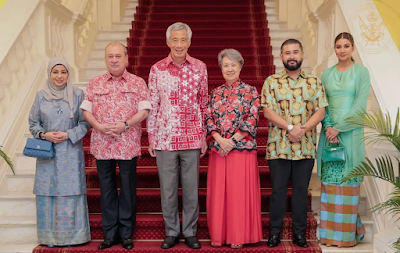
A flurry of news reports this week inform us that Malaysia’s sultans are imminently scheduled to meet and elect the next King of Malaysia from among a set of candidates consisting of only themselves. From the perspective of the Palace of Ghosts story the election, and its outcome, is potentially hugely significant. Singapore Prime Minister Lee Hsien Loong and his wife Madam Ho Ching (centre) hosts the Johor Royals in Singapore in October 2023 The position of King of Malaysia, known in Malay as the Yang di-Pertuan Agong, or simply Agong, was created in 1957 when Malaya gained independence from the United Kingdom. It is, rather uniquely, a rotating office where the Agong is elected by a Conference of Rulers which is made up of the nine traditional rulers of the Malay States. Once elected the Agong remains in office for a period of five years, whereupon another election takes place and a new Agong is elected. The term in office cannot be renewed and what has happened in practice is that ...

Perceiving History with a Bowl of Bak Kut Teh

Image
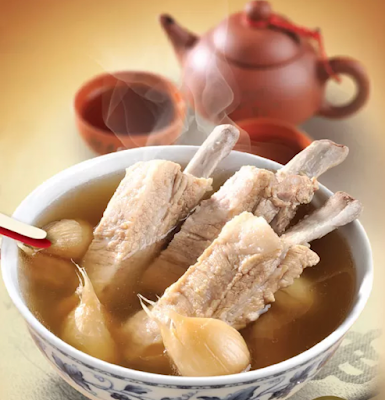
  One of the themes of Palace of Ghosts is historical perspective and memory. I argue that this is a good thing because a shared sense of place and history is a key ingredient to the collective consciousness and collective self-confidence, both of which are vital qualities that help us face uncertainties that the future might hold. The overall result may be peace of mind and happiness. I reason that the more history communities can connect to in a positive way, the greater the sense of well-being. I also quote Winston Churchill when he famously once said, “The longer you can look back, the farther you can look forward”. While this might sound obvious, the challenge can be that we are often unable to see clearly into history because we have a habit of compartmentalising it. We erect figurative screens, either consciously or unconsciously, that can block out episodes from the past. Worse still, sometimes such episodes are erased from history, creating a strange gap in the record. On...