Posts

Showing posts with the label Singapore History

"Johor’s Crown Prince Tunku Ismail may cash out on Singapore’s land in record RM11.4 bil deal"

Image
Tyersall Park in the news again! Throughout its long history Tyersall Park has frequently been in the news: as a leftover from an ancient Malay sultanate; a prestigious stop on the colonial social circuit; a glittering royal palace; the scene of a catastrophic and mysterious fire; a hotbed of scandal and family feuds; wartime tragedies; haunted mansions and forbidden secrets. Find our more about the fascinating story of Tyersall Today’s news is all about development and land values. The region's press came alive again this week with the latest development in the saga surrounding the plot of land, (or more accurately plots of land), located in the heart of District 10, and adjacent to the UNESCO World Heritage Site The Singapore Botanic Gardens. Before this week, the most recent news story came out in June this year. At the time my blog post on the story attracted over 7,000 hits, showing the incredible level of interest in the hidden history behind the headlines.  Learn More About ...

The Tragic Life of Lydia Cecilia Hill

Image
In today’s world, it might be hard to feel much sympathy for someone like Lydia Cecilia Hill. And yet, the young woman known to us as Cecily in Palace of Ghosts emerges as a figure steeped in quiet tragedy, her story threaded with a sense of elegy. It is easy to imagine that some fragile echo of her spirit still clings to the decaying walls of Istana Woodneuk, where she stayed for a brief visit in the 1930s — a fleeting presence now folded into the mansion’s long twilight. Lydia Cecilia Hill (1913-1940) photograph from 1938 Find out more: read the story A Familiar Story Imagine this: a teenage girl with little formal education, from a small country town, but gifted with striking beauty and irresistible talent; she lands a job at a prestigious London dance club. There, she meets a man decades her senior—wealthy, worldly, powerful and handsome. He lavishes her with gifts, praise, and affection. To her, it must have felt like the start of a dazzling new life. It’s a story we’ve heard bef...

One Month Old

Image
Today marks 30 days since the launch of Palace of Ghosts: Singapore's Untold History , and I’m truly overwhelmed by the response it has received. There’s something irresistibly compelling about hidden histories. Even the most devoted fans of fiction seem drawn to the idea that truth—especially the kind long buried—can be stranger than anything imagined. This story, rooted in a distant past yet echoing powerfully into the lives of today’s youth, carries a resonance that feels both timely and timeless. Find of what everybody is talking about   On this one month aniversary of the book's publishing, I would lke to say a big thank you to the many people who have bought the book, who have supported me through thick and thin and believed in the power of this story.

Sultan Ibrahim of Johor (1873-1959)

Image
Sultan Abu Bakar passed away in London, UK, on 4 June 1895 only months after the grand ball at Istana Tyersall. His body was shipped back to Johor where he was laid to rest at the royal mausoleum at Makam Mahmoodiah on 7 September 1895. The creator of Istana Tyersall, his Sultana Fatimah, had been buried there four years earlier in 1891.  His son, Tunku Ibrahim was installed as the new Sultan of Johor in November 1895. Sultan Ibrahim’s reign was to span more than six decades, encompassing two world wars and a host of sensational and dramatic events. Palace of Ghosts dedicates five chapters to this transformative period, during which the Tyersall estate underwent significant changes that in many ways mirrored the sweeping geopolitical and social shifts in both Singapore and Johor. A frequently controversial figure, Sultan Ibrahim's life is a fascinating tale of immense wealth, power, heartbreak, and tragedy—recurring themes woven throughout the narrative of  Palace of Ghosts: ...

A Night Like No Other: Sultan Abu Bakar of Johor's Grand Ball at Istana Tyersall in 1895

Image
With the launch of  Palace of Ghosts: Singapore’s Untold History , (available now on Amazon), I wanted to share a highlight event that features prominently in the story.  Click Here to Buy the Paperback Book In 1895, Sultan Abu Bakar hosted a grand ball to celebrate, in an ostentatious fashion, the opening of Istana Tyersall—a momentous occasion marking not only the opening of Istana Tyersall, but also the launch of a new royal dynasty, one officially recognized by Britain’s Queen Victoria.  There are no known photographs of the Sultan's grand ball, but this depiction of a European royal ball, painted by Wilhelm Gause in 1900, showcases a scene that would have been recognizable to attendees of the Sultan's grand ball at Istana Tyersall in 1895. Throughout his life, Abu Bakar was fixated on inheriting the sovereign title of the defunct Johor-Riau Sultanate: Sultan of Johor. The new state of Johor had been under his firm control for decades by the time he finally achieved h...

The Mystery and Mastery of Tan Yeok Nee (Part 7)

Image
The Singapore Years A 1910 postcard showing the main entrance to The House of Tan Yeok Nee The unexplained departure of Tan Yeok Nee from his official roles in Johor has been interpreted by some as the result of a conspiracy hatched by rivals intent of ousting him from his position of influence in Johor. The previous post explained why this is hard to believe and that an obvious alternative explanation exists: that for years Tan may have been developing a grand plan for a path to semi-retirement. The years following his departure from Johor saw him complete the construction of his palace in Chao’an, China. He would go on to build another beautiful mansion in Singapore, continue his close association with Maharaja Abu Bakar (soon to become Sultan), while continuing to manage his own personal business interests through his Singapore Boat Quay trading company Kwan Hong. Tan may have had a close eye on a quieter life. His new residence in Chao’an, southern China, must have been part of his...

Think Again! The Craft of Inquiry (Part 2)

Image
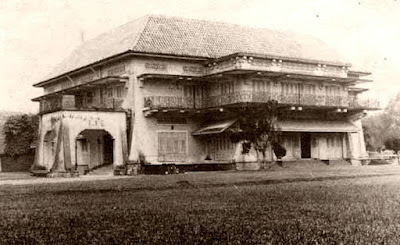
 Think Again! The Craft of Inquiry (Part 2) Istana Woodneuk (circa late 1940s), is the younger "sister" palace of Istana Tyersall. Its ruin still stands on the land which used to be known as Tyersall Park In my previous post I wrote about the manuscript submission process and the questions literary agents ask, in particular the question “why does this book need to be published?” The questioning and answering involved in the submissions process led me to think about the art of questioning in other contexts, such as in business and management, where it is an extremely valuable technique when deployed by masterful questioner. I also presented a couple of examples of the answers I came up with in repose to the question "why does this book need to be be published?" However, the most comprehensive answer to this e question of can be found in the Introduction to Palace of Ghosts : in other words, in the book itself. Here is an excerpt from the book’s Introduction. (3) Th...

The Seeds of Prosperity: Where Did All the Money Come From?

Image
At the peak of his reign in the mid 1920s, Sultan Ibrahim of Johor, Sultan Abu Bakar’s son, was reputed to be the wealthiest man in the world. In addition, the loans that his State of Johor provided to the British bankrolled their global Empire. Where did all the money come from?  One of the perennial themes of Palace of Ghosts is wealth. More specifically, wealth accumulation over time. The most visible sign of this outcome was the flamboyant and ostentatious lifestyle of Sultan Ibrahim of Johor in the 1920s and 1930s. He was a product of his times when the rich lived large and cast caution to the monsoon winds. His outrageous playboy antics provide an entertaining subplot to parts of Palace of Ghosts and get him into all sorts of trouble. However, the wealth of the Sultans of Johor did not, of course, just happen. It started with Abu Bakar, and Chapter 5 of Palace of Ghosts , “A Royal Quest”, tells the story of how it happened. Economic Development The economic profile of the e...