Posts

Showing posts with the label Johor-Riau Sultanate

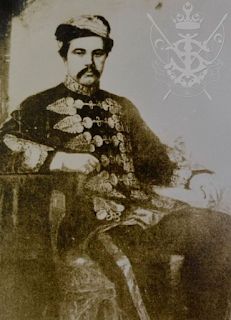
Sultan Ibrahim of Johor (1873-1959)

Image
Sultan Abu Bakar passed away in London, UK, on 4 June 1895 only months after the grand ball at Istana Tyersall. His body was shipped back to Johor where he was laid to rest at the royal mausoleum at Makam Mahmoodiah on 7 September 1895. The creator of Istana Tyersall, his Sultana Fatimah, had been buried there four years earlier in 1891.  His son, Tunku Ibrahim was installed as the new Sultan of Johor in November 1895. Sultan Ibrahim’s reign was to span more than six decades, encompassing two world wars and a host of sensational and dramatic events. Palace of Ghosts dedicates five chapters to this transformative period, during which the Tyersall estate underwent significant changes that in many ways mirrored the sweeping geopolitical and social shifts in both Singapore and Johor. A frequently controversial figure, Sultan Ibrahim's life is a fascinating tale of immense wealth, power, heartbreak, and tragedy—recurring themes woven throughout the narrative of  Palace of Ghosts: ...

The Seeds of Prosperity: Where Did All the Money Come From?

Image
At the peak of his reign in the mid 1920s, Sultan Ibrahim of Johor, Sultan Abu Bakar’s son, was reputed to be the wealthiest man in the world. In addition, the loans that his State of Johor provided to the British bankrolled their global Empire. Where did all the money come from?  One of the perennial themes of Palace of Ghosts is wealth. More specifically, wealth accumulation over time. The most visible sign of this outcome was the flamboyant and ostentatious lifestyle of Sultan Ibrahim of Johor in the 1920s and 1930s. He was a product of his times when the rich lived large and cast caution to the monsoon winds. His outrageous playboy antics provide an entertaining subplot to parts of Palace of Ghosts and get him into all sorts of trouble. However, the wealth of the Sultans of Johor did not, of course, just happen. It started with Abu Bakar, and Chapter 5 of Palace of Ghosts , “A Royal Quest”, tells the story of how it happened. Economic Development The economic profile of the e...

The Extraordinary Rise of Sultan Abu Bakar of Johor

Image
Abu Bakar (1833-1895) was the son of Temenggong Daeng Ibrahim and grandson of Temenggong Abdul Rahman. Temenggong Abdul Rahman was, famously, one the two Malay signatories to the 1819 treaties with the British that allowed them to establish a trading base in Singapore. By the time Abu Bakar succeeded his father as Temenggong in 1862 the other Malay signatory, Tengku Long, had faded into obscurity. That sad fate was not to happen to Abu Bakar: quite the opposite in fact. When Abu Bakar makes his tectonic and far reaching debut appearance in chapter five of  Palace of Ghosts  he is just an eighteen year old youth. Over the course of the next four decades or so he became the highest profile, most charismatic and most wealthy individual that lived in the second half of 19th century Southeast Asia. He eventually founded a new royal dynasty that still exists today (see the recent news articles below). Abu Bakar as a young man Chapter 5 of P alace of Ghosts , A Royal Quest, tells the...

Negara Selat and the Etymology of Riau

Image
I am far from any kind of expert in the field of etymology nor in the Malay language. However, a quick survey of the existing research on the topic provides plenty of food for thought and, like the previous few blog posts, is intended to provide context for the story of Palace of Ghosts. Some of the explanations may be plausible, but cannot be undisputedly proven. The point is to show that Singapore and the surrounding islands and shorelines are far from being disconnected from history. What is important is to strip away the barriers which blur perceptions of the past. Look beyond the modern inventions of borders and cities to see more clearly how the present links to the past and vice versa. The people who today live in territories once occupied by the Johor-Sultanate should look to the island of Sumatra to understand where the people who created the first trading hubs in area originally came from. The zone where mainland Southeast Asia (SEA) meets maritime SEA seems to lack a catchy ...

The Cantankerous Dr. Mahathir Strikes Again

Image
Occasionally an item of news appears that makes me stop and think about how the present engages with the past. It can be a comment from a politician, an announcement from a government department, or an observation by a journalist that arrests the mind for a while and stands out from the dross that unfortunately characterises much of the so-called current events commentary. And the reason why is that it connects to something you had previously thought was important to you in one way or another. A key theme of Palace of Ghosts is the way the past connects to the present. So, I am always on the lookout for those connections, however unlikely their provenance. One of my pleasures in life is waiting for, then reading, the next episode of ex-Prime Minister of Malaysia Mahathir Mohamad, age 96, ranting about something or other. I do find it a little amusing. Rants that are often disguised as a reasoned observation or philosophical musings, but which simultaneously cast aside any semblance of ...

Why Did I Write Palace of Ghosts?

Image
This is a question I am often asked. It is also one that I have also pondered at length. It took me a while to work through the reasons, but I only did so after I had completed the first manuscript. My thought process did not follow a logical, sequential trajectory. I did not, for example, initially identify the reasons I might embark on such a course of action, then weigh up the pros and cons, and then evaluate whether or not to proceed. Rather it was fact a gut feeling. I had to write the story, and the more I researched, the stronger that instinct became. It was only tens of thousands of written words later that I attempted to rationalise why I had done it. The main reasons are those I have set out below. But it’s not an exhaustive list, and I may well come back to these points in a later post. The lure of an untold story . I believe that it is possible to sense history even if there appears to be a gap in the record and you don't know what the missing detail is. There is a deep...