Posts

Showing posts with the label Palace of Ghosts

Part 5: Tokugawa's Final Visit, 1941 – Prelude to invasion

Image
TL;DR – Tokugawa’s Final Visit to Johor (and What It Reveals) In early December 1941, Marquis Yoshichika Tokugawa returned to Malaya—this time in military uniform, as a key adviser to the Japanese 25th Army. Though not a soldier, he was viewed as the Emperor’s trusted emissary. His close friendship with Sultan Ibrahim of Johor proved critical: Johor became the launchpad for Japan’s final push into Singapore. As Japanese generals moved into Istana Bukit Serene—converting its tower into a command post—Tokugawa walked a fine line between diplomacy, loyalty, and personal conviction. Meanwhile, the Sultan, declining evacuation, gambled his life on that friendship. The rest is well-documented history: Singapore fell, the Sultan survived, and Tokugawa escaped trial—shielded, perhaps, by his imperial proximity. But who was Tokugawa really? A monarchist imperialist? A humanist scholar? A spy, a reformer, or both? His story in the Fall of Singapore is largely unknown. But what hidden role did he...

Part 3: Before the Fall – Japanese Influence in Malaya and Singapore

Image
In the last post, we followed Marquis Yoshichika Tokugawa on his first visit to Singapore in 1921—a seemingly low-key personal trip. But Japan’s presence in the region was anything but recent. From the decades old trafficked sex workers trade to growing business networks, Tokugawa arrived as a ground swell of presence was taking place. In Part 3, we trace its evolution—from rising commercial interest to far murkier pursuits. Read Part 2 here

Part 2: Tokugawa Visits Singapore for the First Time, 1921

Image
The previous post explored the theme of historical memory in the lead-up to VJ Day, focusing on the Fall of Singapore in 1942. It introduced Marquis Yoshichika Tokugawa—a largely overlooked figure whose role in those dramatic events has long remained in the shadows. He is one of several key figures whose hidden stories form the untold history at the heart of Palace of Ghosts , all of them intricately connected to the Palace that gives the book its name. In this second post of the series, we begin to unravel his story and ask: Who was Tokugawa? Read Part 1 here Hunter, Scholar, Nobleman The life Sultan Ibrahim of Johor reads like an epic novel—an extraordinary blend of adventure, intrigue and romance. But while the Sultan’s story often steals the spotlight, Palace of Ghosts reveals a cast of equally fascinating characters who shaped his destiny in profound and sometimes surprising ways. One of the most compelling figures in this saga is Marquis Yoshichika Tokugawa—a Japanese aristoc...

Part 1: Marquis Tokugawa – A Forgotten Figure in the Fall of Singapore

Image
VJ Day Victory over Japan Day, the day that World War II (WWII) ended in Asia, is commemorated around the world on both August 15th, when Japan surrendered in 1945, and on September 2 when the surrender documents were formally signed, also in 1945. As the anniversary of VJ Day draws near, ceremonies and reflections will unfold around the world. In Malaysia and Singapore, however, the date passes with relatively little official recognition. The Japanese invasion of Malaya and Singapore, including the Fall of Singapore on February 15, 1942, and ending with Japan’s surrender three and a half years later, remains a defining but selectively remembered chapter in Southeast Asian history. An AI-generated image of Lieutenant General Arthur Percival surrendering to General Yamashita (generated using ChatGPT, June 2025,  prompt: Percival surrendering to Yamashita) Historical Memory: What We Remember ... Or Forget Certain events, and associated images, have become iconic. Some contemporaneous...

Sultan Ibrahim of Johor (1873-1959)

Image
Sultan Abu Bakar passed away in London, UK, on 4 June 1895 only months after the grand ball at Istana Tyersall. His body was shipped back to Johor where he was laid to rest at the royal mausoleum at Makam Mahmoodiah on 7 September 1895. The creator of Istana Tyersall, his Sultana Fatimah, had been buried there four years earlier in 1891.  His son, Tunku Ibrahim was installed as the new Sultan of Johor in November 1895. Sultan Ibrahim’s reign was to span more than six decades, encompassing two world wars and a host of sensational and dramatic events. Palace of Ghosts dedicates five chapters to this transformative period, during which the Tyersall estate underwent significant changes that in many ways mirrored the sweeping geopolitical and social shifts in both Singapore and Johor. A frequently controversial figure, Sultan Ibrahim's life is a fascinating tale of immense wealth, power, heartbreak, and tragedy—recurring themes woven throughout the narrative of  Palace of Ghosts: ...

The Mystery and Mastery of Tan Yeok Nee (Part 2)

Image
Fresh off the Boat: New Friends in Singapore When the youthful Tan Yeok Nee first befriended Abu Bakar at his father’s residential compound at Telok Blangah in Singapore, neither of them could have known how transformational the friendship and, later on, the partnership would become. Those days were, however, still a long way off when Tan first stepped off the boat and onto the shores of Malaya and Singapore. Among immigration societies like Hong Kong and Singapore, there so often appears to be an inverse relationship embedded in the origin stories of how staggering wealth sprouted from humble beginnings: the more successful a tycoon eventually became, the more desperately eccentric his debut in the world of business seemed to be. Hong Kong’s Li Ka-shing starting out as a street vendor of plastic flowers comes to mind. However, it’s not just unique to immigrants nor to Asia: the 1960s entertainment sketch “The Four Yorkshiremen,” immortalized by England’s Monty Python off-beat comedy t...

The Mystery and Mastery of Tan Yeok Nee (Part 1)

Image
Introduction: The Life and Times of Tan Yeok Nee Tan Yeok Nee is a towering figure in the history of 19th-century Johor and Singapore. He started out as a youthful immigrant from China, enduring indentured labour on his arrival in Pahang. He eventually became one of the most powerful men in Johor and Singapore during the 1860s-1880s. Today he has streets named after him in Johor Bahru and buildings that bear his name in Singapore. More fundamentally, however, we see everyday the successful economies of Johor and Singapore and the ever improving livelihoods of their inhabitants. Although he played a major, and foundational, role in creating this phenomenon, relatively little is known about him. This is the first post I have published in some months in the on-going story about the writing of  Palace of Ghosts . The reason for the break is that when I first had the idea to include a post on Tan Yeok Nee, who is an important yet secondary character in Palace of Ghosts, I imagined that...

Think Again! The Craft of Inquiry (Part 2)

Image
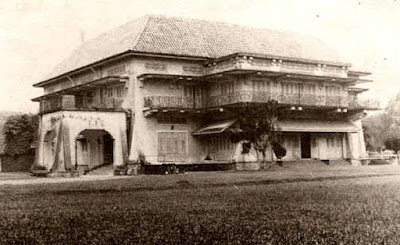
 Think Again! The Craft of Inquiry (Part 2) Istana Woodneuk (circa late 1940s), is the younger "sister" palace of Istana Tyersall. Its ruin still stands on the land which used to be known as Tyersall Park In my previous post I wrote about the manuscript submission process and the questions literary agents ask, in particular the question “why does this book need to be published?” The questioning and answering involved in the submissions process led me to think about the art of questioning in other contexts, such as in business and management, where it is an extremely valuable technique when deployed by masterful questioner. I also presented a couple of examples of the answers I came up with in repose to the question "why does this book need to be be published?" However, the most comprehensive answer to this e question of can be found in the Introduction to Palace of Ghosts : in other words, in the book itself. Here is an excerpt from the book’s Introduction. (3) Th...

Think Again! The Craft of Inquiry (Part 1)

Image
  Think Again! The Craft of Inquiry (Part 1) It is a challenging question to be asked why the book you have worked on for the last couple of years needs to be published. Many of us have experienced that moment of an epiphany or, alternatively, perhaps anxiety when being asked a question which cuts to the bone and challenges some of your most basic beliefs or assumptions. It’s a sobering moment but also one that can open your eyes to unexpected currents of thought or avenues of inquiry. It is also a useful technique that can be utilised in management or even in navigating personal relationships. It plays a critical role in helping to develop people to think differently or creatively. In an earlier post I wrote about why I decided to write Palace of Ghosts ( See here ), but the new question of why the book needs to be published, did indeed succeed in making me think differently about my own ideas and assumptions, as well as about the art of masterful questioning more generally. An Ag...