Posts

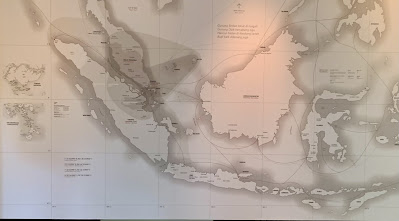
Negara Selat and the Etymology of Riau
Image
I am far from any kind of expert in the field of etymology nor in the Malay language. However, a quick survey of the existing research on the topic provides plenty of food for thought and, like the previous few blog posts, is intended to provide context for the story of Palace of Ghosts. Some of the explanations may be plausible, but cannot be undisputedly proven. The point is to show that Singapore and the surrounding islands and shorelines are far from being disconnected from history. What is important is to strip away the barriers which blur perceptions of the past. Look beyond the modern inventions of borders and cities to see more clearly how the present links to the past and vice versa. The people who today live in territories once occupied by the Johor-Sultanate should look to the island of Sumatra to understand where the people who created the first trading hubs in area originally came from. The zone where mainland Southeast Asia (SEA) meets maritime SEA seems to lack a catchy ...

The Cantankerous Dr. Mahathir Strikes Again

Image
Occasionally an item of news appears that makes me stop and think about how the present engages with the past. It can be a comment from a politician, an announcement from a government department, or an observation by a journalist that arrests the mind for a while and stands out from the dross that unfortunately characterises much of the so-called current events commentary. And the reason why is that it connects to something you had previously thought was important to you in one way or another. A key theme of Palace of Ghosts is the way the past connects to the present. So, I am always on the lookout for those connections, however unlikely their provenance. One of my pleasures in life is waiting for, then reading, the next episode of ex-Prime Minister of Malaysia Mahathir Mohamad, age 96, ranting about something or other. I do find it a little amusing. Rants that are often disguised as a reasoned observation or philosophical musings, but which simultaneously cast aside any semblance of ...

Land, Sea and Weather: Nature's Gift to Singapore

Image
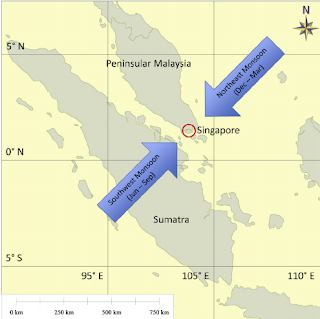
For many Singapore residents and visitors alike, the heat, humidity, and heavy downpours appear consistent and relentless–random and frequent bouts of intense weather. When it rains, it really rains hard, and yet it remains hot, cooling noticeably in the hours after the downpour dissipates. Sometimes, it seems to be simultaneously raining and sunny!  Having spent my childhood in the dreary north of England’s cold drizzle, I know a little bit about rain, but in Singapore, the rain is astonishing in its often damaging power and volume. A tropical storm, including the frequent Sumatra squalls that scurry across the Straits of Malacca, hit Singapore like a sledgehammer. It is an amazing spectacle. It is a genuinely awesome demonstration of nature’s raw power. Despite billions the dollars spent by Singapore on canals and drainage systems, Singaporeans regularly receive SMS notifications about the dangers posed by flash floods, falling trees, and other weather-related mayhem.  Washe...

Every Story Has a Beginning

Image
While Palace of Ghosts makes no claim to be a history of Singapore, it is a Singapore story based on real events, and one that looks beyond the founding narrative of Raffles and 1819. The story begins earlier not to challenge any existing narrative, official or otherwise, but simply because that is where a more logical beginning point exists relative to the linked events that subsequently transpired. The idea of continuity – the links in the historical chain of events connecting the past to the present and extending into the future - arises time and again throughout Palace of Ghosts. It’s opposite, discontinuity, is an ever-present shadow, lurking in the background. I preferred, however, the notion of erasure over discontinuity as that shadow, because in many unfortunate cases erasure is the cause of discontinuity. But erasure can be a slow process because of evidence that stubbornly continues to exist. In Palace of Ghosts Istana Tyersall and Istana Woodneuk – the two palaces which fea...

The Discovery of Tyersall

Image
The starting point for my discovery of Tyersall was a map. I’d like to say it was an antique map retrieved from the bowels of a hidden library: something that Dan Brown might have written about, or an adventure that Indiana Jones might have inadvertently got involved in. However, to me it was more intriguing. It was an online map that I was studying but for a completely unrelated purpose. As I moved my cursor across a patch of forest that I was planning to jog around, I was surprised to see an unusual name pop up and a symbol that indicated a building of historical significance.  It was so unexpected. Having lived in Singapore for 16 years and paying a great deal of attention to its history and architectural heritage, I thought I was aware of most of its important historical sites and buildings. Here was something right next door to where I lived that I had missed and that appeared to be forgotten. The name was “Istana Woodneuk”, and I knew enough Malay to understand that “Istana” ...

Why Did I Write Palace of Ghosts?

Image
This is a question I am often asked. It is also one that I have also pondered at length. It took me a while to work through the reasons, but I only did so after I had completed the first manuscript. My thought process did not follow a logical, sequential trajectory. I did not, for example, initially identify the reasons I might embark on such a course of action, then weigh up the pros and cons, and then evaluate whether or not to proceed. Rather it was fact a gut feeling. I had to write the story, and the more I researched, the stronger that instinct became. It was only tens of thousands of written words later that I attempted to rationalise why I had done it. The main reasons are those I have set out below. But it’s not an exhaustive list, and I may well come back to these points in a later post. The lure of an untold story . I believe that it is possible to sense history even if there appears to be a gap in the record and you don't know what the missing detail is. There is a deep...

The Story of Palace of Ghosts

What should readers expect when they begin their journey through the pages of Palace of Ghosts ? Palace of Ghosts is a narrative history, sometimes referred to as a creative work of nonfiction, or historical nonfiction. It tells a chapter of history that appears to have been overlooked, but not completely undocumented. Some of the events and characters have been written about before, but often compartmentalised into their particular era. As such there is no existing or obviously explained link between them all. Their moments in the grand arc of historic storytelling seem to be isolated from one another. But in the truth, they are not; they are very much connected to each other. The story arc of Palace of Ghosts looks past the artificial truncations that various administrations over the centuries make from time to time, each peddling their own version of official history. As we consider how the present engages with the past, and the how past influences the future, todays’ residents of...